
Golf scorekeeping: A beginner’s guide
30 January 2026
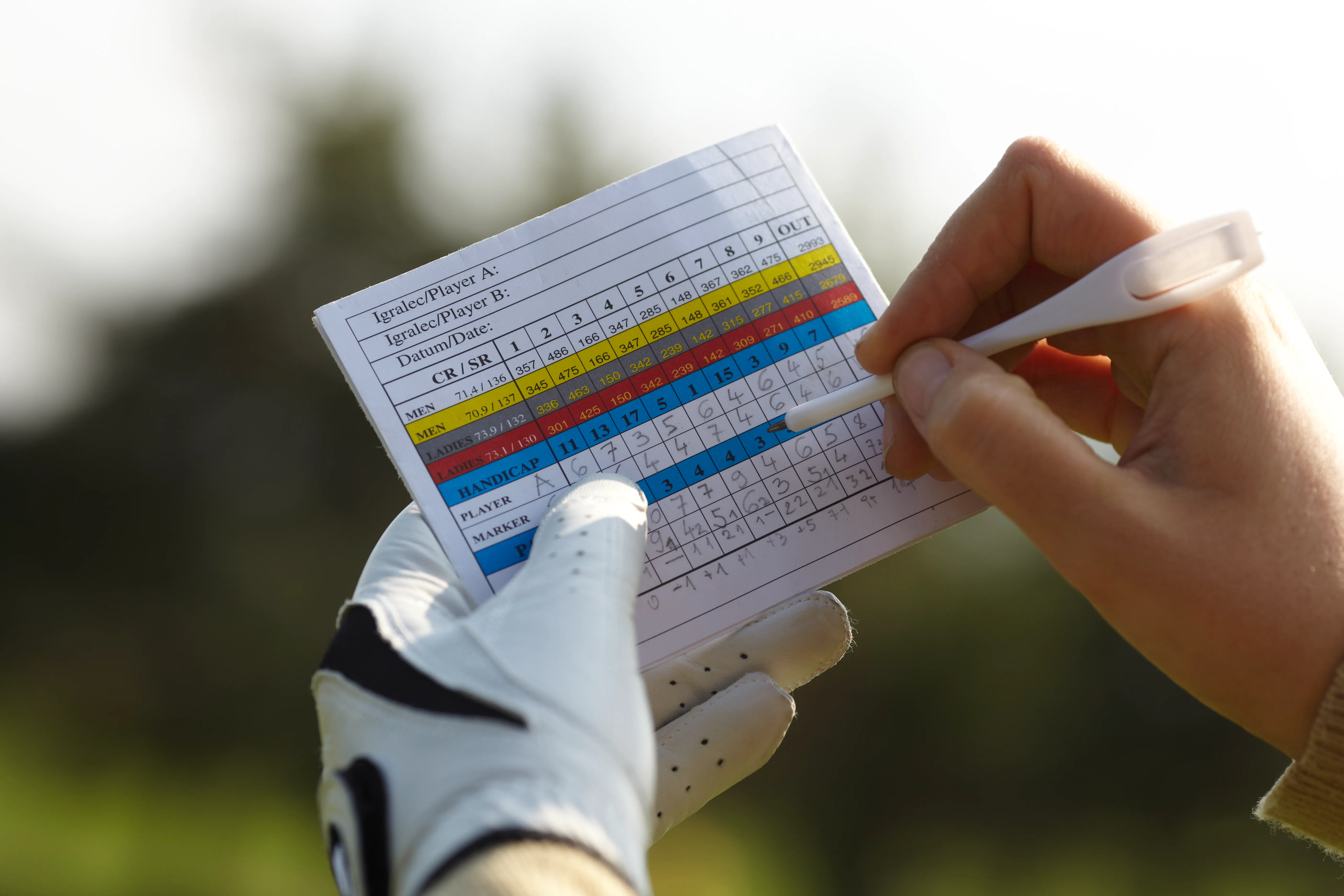
Understanding golf scorekeeping is critical to enjoying a round and playing properly. For beginners, it may seem like a complex task to fully grasp the intricacies of the sport as a whole, let alone its various forms, where rules can differ substantially. But fear not! Golf scorekeeping isn’t as difficult as it sounds, and all it takes is a little practice to fully get on board.
In this guide, we’ll look at golf scoring systems across the most common formats of stroke play and match play, as well as the differences in variations such as mulligan scoring. We’ll also detail how to fill out a scorecard correctly.
The basics of golf scorekeeping
First things first, in golf, the aim of the game is to achieve as much as possible in the fewest hits of the ball, or strokes as they’re known.
Each hole has a ‘par’, referring to the number of strokes expected to complete the hole. Golfers would be expected to complete a hole with a par of three in three strokes. It’s that simple. Handicaps are a notable caveat of this, but we’ll discuss that later.
At this stage, it’s important to get familiar with some of the terminology, including:
- Ace/hole in one: completing a hole in only one stroke
- Condor: completing a hole four strokes under par
- Albatross/double eagle: completing a hole three strokes under par
- Eagle: completing a hole two strokes under par
- Birdie: completing a hole one stroke under par
- Par: completing a hole in the expected number of holes
- Bogey: completing a hole one stroke over par
- Double bogey: completing a hole two strokes over par
- Triple bogey: completing a hole three strokes over par
- Quadruple bogey: completing a hole four strokes over par
This is all largely consistent among the different types of golf. The main difference is the importance of how quickly you complete the whole course versus how quickly you complete each hole.
Golf scorekeeping in stroke play

There are two main ways of playing golf, and the one you’re most likely to encounter in your first forays into the sport is stroke play.
In stroke play, the victor is decided by who completes the entire round in the fewest shots (typically 18 holes, but it could be nine). You’ll keep track of how many strokes it takes to finish each hole and then add these up throughout the round.
The player with the lowest score wins.
Golf scorekeeping in match play
Broadly speaking, the way you play a round of match play doesn’t change on a hole-by-hole basis. You’re still trying to complete each hole in the fewest number of strokes.
However, the victor here is the golfer who wins the most holes. If you finish one hole in fewer strokes than your opponent, you’ll go one up. If you win another, you’ll go two up, then three up and so on. If you’re level, it’s known as all square. If you’ve won six holes and your opponent five, you wouldn’t be winning six-five. Instead, you’re one up.
The winner is the player who has won the most holes after all nine or 18 are completed.
The impact of handicaps on golf scorekeeping
That’s all well and good, but including handicaps can make things slightly more complicated.
What are handicaps?
Each player has a handicap (or handicap index, as it has become known) associated with them, which indicates their overall ability. The lower the number of your handicap, the better you’re expected to perform.
For example, the best handicap is zero, and a golfer with this is known as a ‘scratch golfer’. These golfers are good enough to consistently complete each hole in the expected number of shots, always (or at least very regularly) achieving par.
Most golfers, however, will find their handicaps in the double digits. A handicap of 15 is still good going.
How handicaps affect scoring
Handicaps aren’t just indicators of ability. They serve a purpose, and this differs slightly between stroke play and match play.
In stroke play, you deduct your handicap from your total score (gross score) to create a final score (net score). A player with a handicap of 15 who completed a round with a gross score of 100 would end up with a net score of 85, for example.
It’s a little more complicated in match play. Here, you deduct strokes from holes based on what’s known as the stroke index – this, broadly speaking, measures the difficulty of each hole. A player with a handicap of 15 would deduct a stroke from the 15 hardest holes according to the stroke index, turning a par into a birdie and so on.
The point of including a handicap in golf scorekeeping is to ensure that players of differing abilities can still compete on a level playing field.
A scratch golfer would be expected to beat our golfer with a handicap of 15 more or less every time without a handicap. With one, the outcome isn’t so sure.
Penalties, mulligans and other variations in golf scorekeeping

When things go awry in golf, you may find yourself incurring a penalty and adding additional strokes. If your ball goes into a penalty area (bodies of water on the course, for example), you’ll have to add an additional stroke. If you hit your ball out of bounds, you must add two additional strokes, so beware!
However, one way of avoiding these consequences is playing a round with mulligan scoring.
With mulligan scoring, you may be afforded a retake after a bad shot, thus avoiding a penalty. These are often given on early shots (a poor tee, for example), and they will be offered by another player in your party.
Remember, mulligans are for friendly rounds only. Don’t expect to be afforded them in a competitive game.
The role of the scorecard in golf scorekeeping
Finally, the scorecard is where you keep track of everything that’s happening throughout your game – every hole, every stroke, every score.
Each scorecard contains a grid in which the rows refer to players and the columns to the holes. These are specific to each course and, as such, contain information unique to each. A scorecard will let you know, for each numbered hole, from where you can tee off (yardage), the par and the stroke index.
Remember to factor in handicaps when playing a round that involves them. For a round of match play, the inclusion of this stroke index will help you out considerably.
One player is responsible for keeping track of the score throughout the round. Usually, you’ll work out your score for the first nine holes before combining it with your score for the second set.
Specialist golf insurance through Golf Care
Once you’ve learnt how to count your scores properly, you may want to consider getting specialist golf insurance before your next round.
Through Golf Care, policies include Equipment Cover up to £7,500, Public Liability of up to £10m, and Personal Accident Cover up to £50,000. Get a quote online today.
Please note the information provided on this page should not be taken as advice and has been written as a matter of opinion. For more on insurance cover and policy wording, see our homepage.