
What are yellow stakes in golf?
27 July 2026
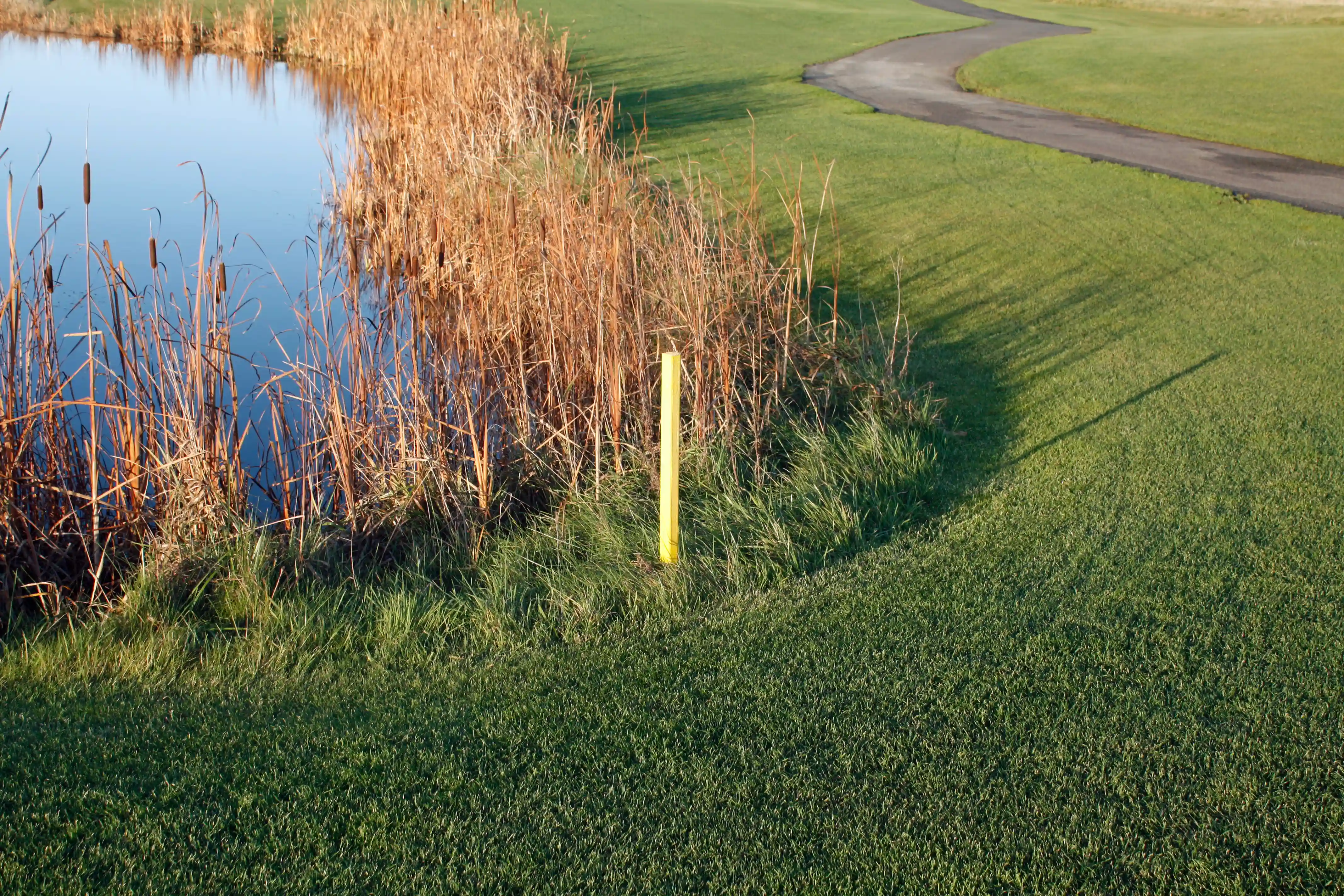
Nobody wants to hit the ball into penalty areas, but inadvertently directing a shot within the yellow stakes is, unfortunately, something that will happen to every golfer at least once. In this guide, you’ll discover exactly what you can and can’t do after finding your ball within the yellow stakes in golf, so you play within the rules and don’t find yourself picking up extra penalties.
What do yellow stakes mean in golf?
Yellow stakes in golf mark out penalty areas. This typically covers water hazards, but also thick foliage, jungle areas, and desert spots. It all depends on where you’re playing in the world.
These are different to red stakes, which mark out penalty areas, which are typically used for lateral water hazards. This is important. If your ball lands in a penalty area marked by red stakes, you have an additional relief option unavailable to you if your ball lands in a penalty area marked by yellow stakes. But we’ll get to that shortly.
What are your options after hitting the ball into an area marked by yellow stakes?
There are three main options you can use if you hit the yellow stakes in golf:
- Playing the ball from where it landed
- Stroke-and-distance relief
- Back-on-the-line relief
Two of these involve penalty strokes, and sometimes your options are limited.
Playing the ball where it landed
The first option is to play the ball from where it landed within the penalty area. This is a unique option, as it’s the only one which won’t incur the addition of a penalty stroke. However, the downside of this is that your ball may be in an exceedingly tricky position at best, or a totally unplayable one at worst.
Sometimes, your hands are tied. Even if you wish to play your ball from the position it landed within the penalty area marked by yellow stakes, it’s impossible to do so. Other times, it may technically be possible, but just unwise.
That’s where your next two options become available. The idea of these two is that you have a get-out-of-jail-card if your ball is totally unplayable within the penalty area, or the new shot is markedly easier. Of course, the trade-off is that you’ll receive a penalty stroke.
Stroke-and-distance relief
The first of these two choices is stroke-and-distance relief. Here, you go back to where your previous stroke was taken from and replace the ball before, essentially, retaking the shot from the same place. There is some leeway. You’re allowed to drop the ball within a club length of the position of the original shot, just as long as you’re not giving yourself an advantage by getting closer to the hole.
It can be particularly useful to use this option when you’ve hit the ball into yellow stakes immediately from teeing off. This way, you know precisely where to retake your shot from. And you have the advantage of hitting the ball off the tee again, as opposed to off the ground.
If you suspect your ball has landed in a yellow stakes penalty area, but you’re not certain (or at least very, very nearly certain), then stroke-and-distance relief is your only option. You can’t play the ball from within the penalty area, as you’re not totally sure of where it is. And you can’t choose the next relief option because you’re not sure enough about where the ball entered the penalty area.
Back-on-the-line relief
If you are certain or almost certain that your ball is in the penalty area, you have more options and may find that stroke-and-distance relief isn’t the optimal choice. Particularly if the distance between the original shot and the penalty area is significant.
This is when you may choose to use back-on-the-line relief. In this instance, you’re not forced to return tens of metres back as would potentially be the case with stroke-and-distance relief. Instead, all you need to do is locate the approximate point at which your ball entered the penalty area, before retreating backwards. The beauty of this is that there is no limit as to how far backwards you are or aren’t allowed to go. Once you’ve reached your desired spot, stretch your arm out straight and drop the ball onto the ground. You aren’t allowed to flick your wrist with this drop. Just allow the ball to fall out of your hand.
There are three caveats to this rule, however. The R&A, as part of rule 17.1d, explains that that ball:
- “Must not be nearer the hole than the estimated point where the original ball last crossed the edge of the penalty area, and
- May be in any area of the course except the same penalty area, but
- Must be in the same area of the course that the ball first touched when dropped.”
This means that you’re not allowed to gain any advantage by placing the ball closer to the hole than where it entered the penalty area, but also that you aren’t allowed to drop your ball elsewhere in the penalty area even if it’s practical to do so. Say your ball lands in a body of water, but there’s a small amount of grass between it and the yellow stakes. You still can’t drop the ball within the penalty area. You must drop it outside the stakes.
In the same way as in stroke-and-distance relief, you’re allowed to drop the ball within a club length in either direction so long as you aren’t closer to the hole.
Your three yellow stakes options: A quick summary
To recap, your three options are:
- Play the ball from where it landed within the penalty area. This is often not practical, nor indeed possible, but it’s still an option if it’s viable and desired. You won’t be awarded a penalty stroke for this.
- Stroke-and-distance relief, whereby you return to the position of your previous shot and retake from that approximate spot (within a club length). This incurs a penalty stroke.
- Back-on-the-line relief. Retreat from the position the ball entered the penalty area, drop the ball and take the shot from within a club length of this spot. You must not take the shot from within the yellow stakes.
Yellow stakes vs. red stakes
There’s one big mistake you must avoid. Confusing yellow stakes with red stakes.
Penalty areas marked by red stakes are typically parallel to the fairway and allow for one additional relief option. Lateral relief.
In this case, you’re allowed to measure two club lengths directly lateral to the border of the penalty area, subsequently reaching a position on the fairway, before taking your shot from there. This option is not available for yellow stakes penalty areas because they aren’t lateral to the fairway.
Understanding yellow stakes in golf
If you find your ball within the yellow stakes in golf, remember your three options. And don’t confuse it with red stakes. Most importantly, if you do hit the ball into a penalty area, don’t panic! It happens to everyone, and if you know the rules, you’re already doing better than many.
Keen to learn more about the rules and regulations of golf? Discover what a golf mudball is and how a drop works in golf.
Specialist golf insurance through Golf Care
Before you head out onto the course next, you may want to consider protecting yourself and your golf equipment with specialist golf insurance. Get a quote online today.
Please note the information provided on this page should not be taken as advice and has been written as a matter of opinion. For more on insurance cover and policy wording, see our homepage.